Reverse Osmosis vs Carbon Filtration: Which is the Best Water Purifier for Your Home?
Choosing a water filter should not come down to guesswork. With options ranging from simple $30 kitchen pitchers to $500 advanced under-sink systems, it is hard to tell what you are actually paying for. In residential water treatment, most choices come down to two popular technologies: Activated Carbon Filters and Reverse Osmosis (RO) Systems.
Choose a Carbon Filter if you are on standard city water, your local water report already meets safety guidelines, and your main goal is to remove the smell of chlorine and improve daily taste. It is affordable, zero-waste, and tool-free.
Choose Reverse Osmosis (RO) if your home relies on private well water, or if you live in an area with old infrastructure where you want targeted reduction of lead, heavy metals, fluoride, nitrates, and high Total Dissolved Solids (TDS). It costs more upfront, but it delivers a much deeper level of purification.
To help you find the right system for your daily routine, plumbing layout, and budget, let's break down how these two systems compare in the real world.
1. Understanding the Technology (In Plain English)
Activated Carbon Filters: The "Sponge" Approach
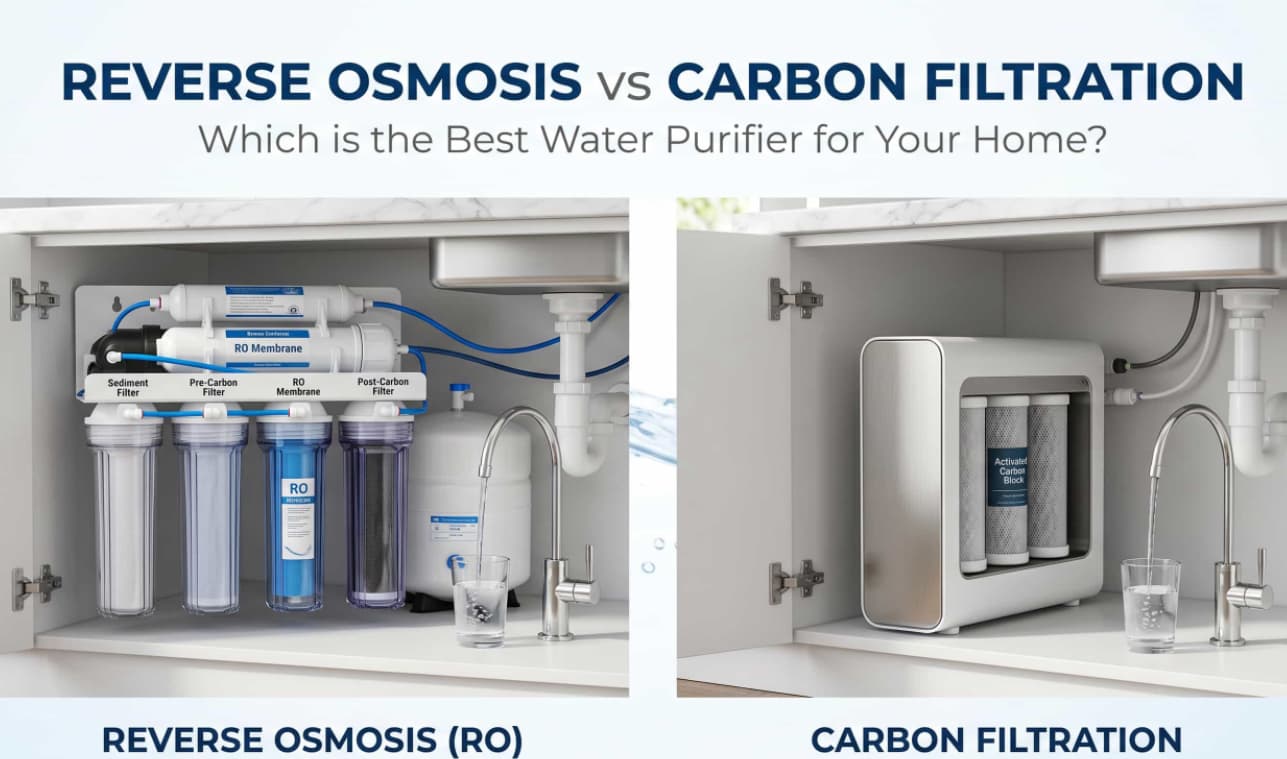
Think of an activated carbon filter as a dense, microscopic sponge. As water passes through a carbon block, it naturally attracts and traps chemical impurities like chlorine, volatile organic compounds (VOCs), and common agricultural pesticides. Your water smells and tastes fresh immediately. However, carbon filters do not reduce dissolved inorganic solids. Minerals, salts, and heavy metals slip right through them because they cannot bond to carbon alone.
Reverse Osmosis (RO) Systems: The "Tight Screen" Approach
A Reverse Osmosis system uses a multi-stage approach. After the water passes through basic pre-filters (usually carbon), it is forced under high pressure through an incredibly tight semi-permeable membrane. The pores on an RO membrane are roughly 0.0001 microns, so small that they physically block almost everything except pure water molecules. Dissolved solids, lead, arsenic, and nitrates are separated, rinsed off the membrane, and flushed down the drain, leaving highly purified drinking water.
2. Side-by-Side Comparison Matrix
When you look past the tech specs, how do these systems impact your kitchen real estate, plumbing, and annual household expenses? Let's compare them across high-frequency decision points:
| Feature / Decision Factor | Activated Carbon Filter | Reverse Osmosis (RO) System |
|---|---|---|
| Primary Purpose | Improves taste, odor, and removes chlorine | Provides deep purification of dissolved solids |
| Upfront Hardware Cost | Lower ($30 - $120) | Moderate to Higher ($200 - $600) |
| Yearly Maintenance Costs | $40 - $80/year (filters swap every 3-6 months) | $60 - $120/year (RO membranes last 12-24 months) |
| Installation Effort | Very Easy (often tool-free faucet/pitcher setup) | Moderate (requires below-sink line connections) |
| Water Production Waste | Zero Waste (100% of incoming water is utilized) | Yes (flushes out rejected solids to the drain line) |
| Dispensing Flow Speed | Fast (uses your normal faucet line pressure) | Slower (requires a storage tank or internal pump) |
| Renter-Friendly Layout | Excellent (leaves no trace when moving out) | Model Dependent (under-sink requires approval; countertop RO is plug-and-play) |
| Best Suited For... | Standard municipal water with taste/odor issues | Private well water, hard water, or high-risk grids |
3. Which One Fits Your Daily Living Scenario?
If your local municipal reports show no heavy metal failures or lead plumbing risks, a carbon filter is often the smartest, most practical value. A high-quality carbon pitcher or faucet mount will easily clean up seasonal chlorine smells without wasting a drop of water or requiring plumbing adjustments.
Private wells are unregulated and highly susceptible to agricultural runoff (nitrates), natural heavy metals (arsenic), and high dissolved mineral scaling. Here, a carbon filter is structurally insufficient. You need the physical barrier of an RO membrane to ensure long-term drinking safety.
Explore high-capacity RO systems optimized for complex water profiles →When dealing with housing built before lead service line regulations, the water treatment plant is not the issue, the delivery pipes are. Older plumbing increases the risk of lead and copper leaching into your kitchen tap. Because lead is a heavy metal ion, reverse osmosis provides the rigorous protection required to isolate it from your drinking supply.
Many renters avoid RO because traditional under-sink systems require drilling into pipes or countertops. However, modern countertop reverse osmosis systems offer a zero-modification alternative, giving you multi-stage purification that plugs into any outlet and leaves no permanent trace behind.
4. Addressing the Most Common Homeowner Concerns
Does Reverse Osmosis waste too much water?
This is a major concern for many buyers. Legacy under-sink RO setups used to waste 3 to 4 gallons of water for every single gallon of pure water produced, mainly due to the constant backpressure of bulky storage tanks.
Modern engineering has changed this dynamic. Today's high-efficiency, tankless RO systems utilize integrated internal booster pumps to cut that waste down significantly, achieving clean 1:1 or 2:1 pure-to-drain ratios while filling your glass in seconds.
Is RO water "too purified" because it removes minerals?
While it is true that an RO membrane removes minerals like calcium alongside harmful contaminants, biological data shows that humans get over 95% of their daily essential minerals from solid food such as vegetables, grains, and proteins, not from drinking fluids. The safety benefit of filtering out localized heavy metals or chemical runoff far outweighs the negligible loss of waterborne minerals.
5. Making Your Final Verdict
There is no single "best" water filter, only the right filter for your specific water lines.
- Choose Carbon if you want better-tasting water, zero wastewater, lower initial costs, and simple maintenance on clean city lines.
- Choose Reverse Osmosis if you want broader protection against heavy metals, fluoride, or nitrates, use well water, or live in a home with aging pipes.
At Mizudo, we design our systems to solve the traditional trade-offs of home filtration. Our tankless RO series, including the Megaflo Smart Mini (800GPD & 1000GPD) and high-flow Megaflo Smart (1200GPD), are engineered without bulky storage tanks, maximizing your below-counter space while delivering exceptional flow rates and ultra-low water waste. For smaller kitchens or tight apartments, our mini appliance models focus specifically on compact efficiency without compromising filtration depth.
Fully CSA Certified to meet North American safety standards, Mizudo hardware is trusted by households nationwide and available through leading retail channels like The Home Depot and Lowe's. If you are ready to transition to a higher tier of home water security, browse our certified lineup or connect with our support specialists at service@mizudo.com to evaluate your local water profile.
Frequently Asked Questions (FAQ)
Yes, and virtually all premium RO systems do this automatically. An RO membrane is sensitive to chlorine, so advanced systems use a pre-carbon filter to remove chlorine first, protecting the membrane and helping the multi-stage system last longer.
Yes. Within compact appliance lines, 10-gallon systems are often positioned as small-tank or mini units. They are designed to fit tighter under-sink spaces while maintaining stable water delivery for everyday residential use.