


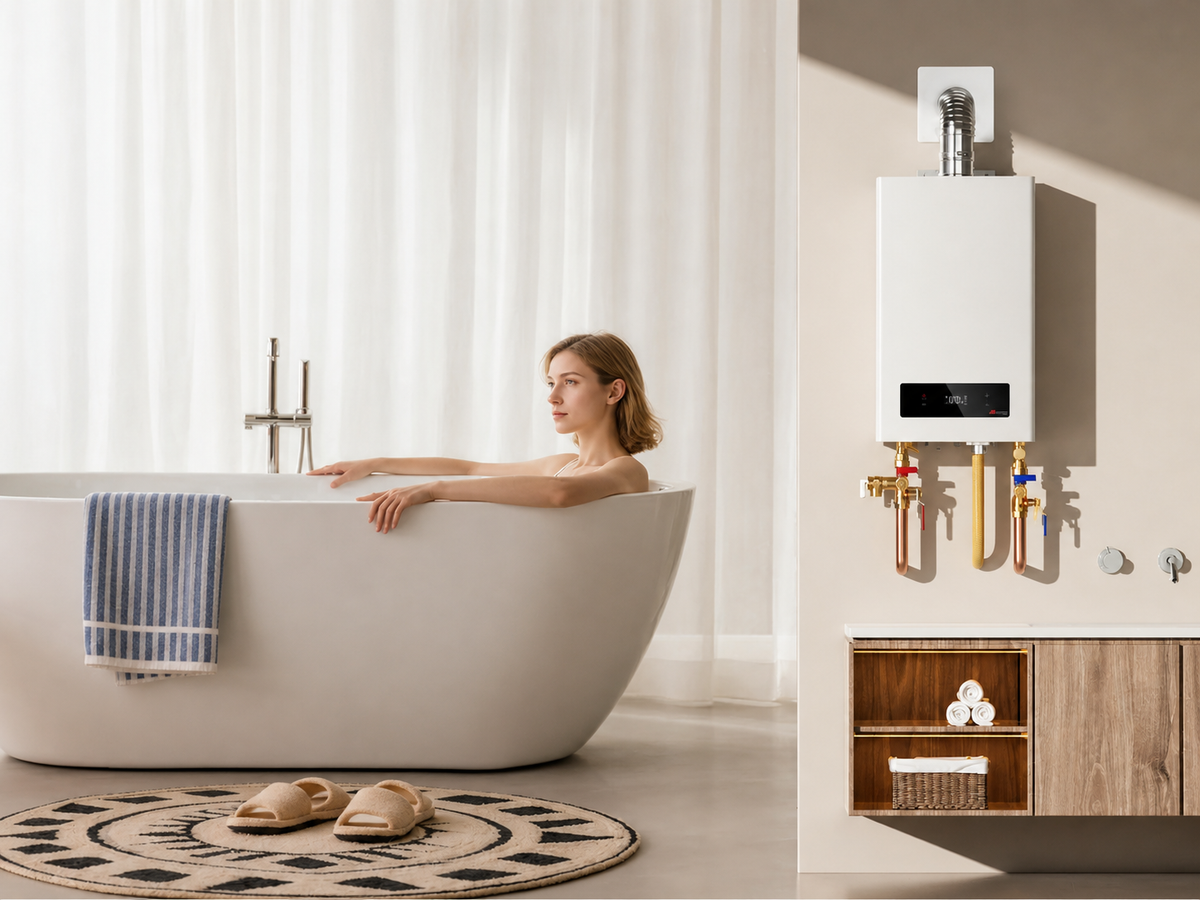
Where you install a propane tankless water heater can have a real impact on both installation and long-term use. An indoor unit keeps the heater protected from the weather, while an outdoor model can save indoor space and eliminate the need to route an exhaust vent from inside the home.
That doesn’t mean one is always better than the other. The right choice depends on your climate, available installation space, existing water and propane connections, venting options, and the amount of hot water your household needs. The comparison below shows where each option tends to make the most sense.
Indoor vs. Outdoor at a Glance
| Decision Factor | Indoor Propane Model | Outdoor Propane Model |
|---|---|---|
| Weather exposure | Protected from direct rain, wind, and outdoor temperature swings | Must be designed for outdoor use and installed within its weather limits |
| Venting | Requires an approved route to discharge combustion exhaust outdoors | No separate indoor-to-outdoor exhaust run is needed |
| Freeze planning | Generally less exposed to freezing, depending on the indoor location | Heater and exposed water lines need model-specific freeze protection |
| Space | Uses interior or protected utility space | Preserves indoor utility space but requires a suitable exterior wall |
| Retrofit work | Convenient when an existing indoor vent route can be reused or replaced easily | May reduce indoor vent work but require gas and water lines to be relocated |
| Service access | Usually easier when installed in an accessible utility area | Depends on mounting height, weather, landscaping, and exterior access |
Climate Is One of the Biggest Factors
If your area regularly experiences freezing temperatures, an indoor propane tankless water heater is generally easier to protect. The building provides an additional layer of protection from cold weather, wind, snow, and other outdoor conditions.
Outdoor tankless water heaters may include built-in freeze-protection features, but that does not make every model suitable for every winter climate. The Building America Solution Center recommends following the manufacturer’s climate and installation requirements. Exposed water lines also need protection, and some freeze-protection systems depend on continuous electrical power.
Before choosing an outdoor unit, check the exact model’s temperature limits, freeze-protection requirements, and instructions for severe weather or power outages. Don’t rely on a general freeze rating found online—always follow the installation manual for the specific model you choose.
In warmer climates where freezing is less of a concern, outdoor installation can be an attractive way to save indoor space and simplify venting.
How Installation Differs Indoors and Outdoors
Indoor propane tankless water heaters need an approved way to discharge combustion exhaust outside the home.
Depending on the model, this may involve a direct-vent or power-vent system with specific vent materials, termination locations, and clearances. If the proposed installation area is near an exterior wall and has a straightforward vent path, indoor installation may be relatively simple. Longer vent routes, finished walls, or unsuitable existing chimneys can make the job more complicated.
Outdoor-rated units exhaust directly at the appliance, so they don’t require a vent pipe running from an indoor unit through the wall or roof. This can reduce installation work when a practical indoor vent route isn’t available.
However, outdoor installation still requires proper placement. The installer must consider clearances from windows, doors, and air intakes, as well as access to propane, water, electricity, and future servicing.
Distance from the home’s plumbing also matters. Installing the heater farther from frequently used fixtures can mean longer pipe runs and a longer wait for hot water.
So while outdoor installation may save the cost of an indoor exhaust route, other work—such as relocating utilities or providing freeze protection—can offset some of those savings.
Which MIZUDO Propane Tankless Water Heater Fits Your Installation?
MIZUDO offers propane tankless water heaters for indoor, outdoor, and convertible installations, so the best starting point is to narrow down where the heater can be installed and how much hot water your home needs.
The examples below can help you narrow down the installation type and capacity that may fit your home. Keep in mind that actual hot-water flow varies with incoming-water temperature and the required temperature rise.
| MIZUDO Example | Installation Type | Published Capacity | Good Starting Point For |
|---|---|---|---|
| 4.0 GPM 90,000 BTU model | Indoor, power vent | 4.0 GPM / 90,000 BTU | Lighter hot-water demand with a suitable indoor vent route |
| 5.1 GPM 120,000 BTU outdoor model | Outdoor | 5.1 GPM / 120,000 BTU | Moderate demand with a suitable outdoor installation location |
| 5.1 GPM 120,000 BTU convertible model | Indoor/outdoor convertible with required accessories | 5.1 GPM / 120,000 BTU | Homes that need manufacturer-approved installation flexibility |
| GEN 3 10.3 GPM 199,000 BTU model | Indoor, direct vent | Up to 10.3 GPM / 199,000 BTU | Higher whole-home demand with a planned indoor direct-vent installation |
These aren’t simply different sizes of the same heater. Installation location, venting, propane configuration, temperature rise, and available utilities all need to match the model.
You can explore the full MIZUDO propane tankless water heater collection after deciding whether indoor, outdoor, or convertible installation makes the most sense for your home.
What to Confirm Before You Choose
Installation location is only part of the decision. A home where one shower is normally used at a time has different requirements from one running two showers and a kitchen faucet together. Colder incoming water can also reduce the hot-water flow available at the desired temperature.
You also need to confirm the correct fuel and installation configuration.
A product offered in both Natural Gas and Propane versions must be ordered in the correct fuel configuration. Likewise, an indoor-only model should not be installed outdoors unless the manufacturer specifically approves that configuration.
A convertible model is different: it may support indoor or outdoor installation when the required MIZUDO accessory kit and installation instructions are followed.
Before ordering, ask your installer to confirm:
- Indoor, outdoor, or convertible approval
- Propane/LP configuration
- Required hot-water flow
- Venting or outdoor clearances
- Propane supply and regulator capacity
- Freeze protection where needed
- Access for future maintenance
Frequently Asked Questions
Can an indoor propane tankless water heater be installed outside in a cabinet?
Not unless the manufacturer specifically approves that model and configuration for outdoor use. Adding a cabinet does not turn an indoor-only heater into an outdoor-rated model. Choose an outdoor model or a manufacturer-approved convertible model instead.
Does an outdoor propane tankless water heater need venting?
Outdoor models vent combustion gases directly at the appliance, so they don’t need a separate exhaust pipe routed through the home. They still must be installed in an approved exterior location with the clearances and placement requirements specified in the manual.
Does an outdoor model use more propane than an indoor model?
Not simply because it’s installed outdoors. Propane use depends more on the efficiency and performance of the specific heater, household hot-water demand, incoming-water temperature, and desired water temperature.


Leave a comment
This site is protected by hCaptcha and the hCaptcha Privacy Policy and Terms of Service apply.