


Reverse Osmosis vs Carbon Filtration: Which Water Filter Is Right for You?
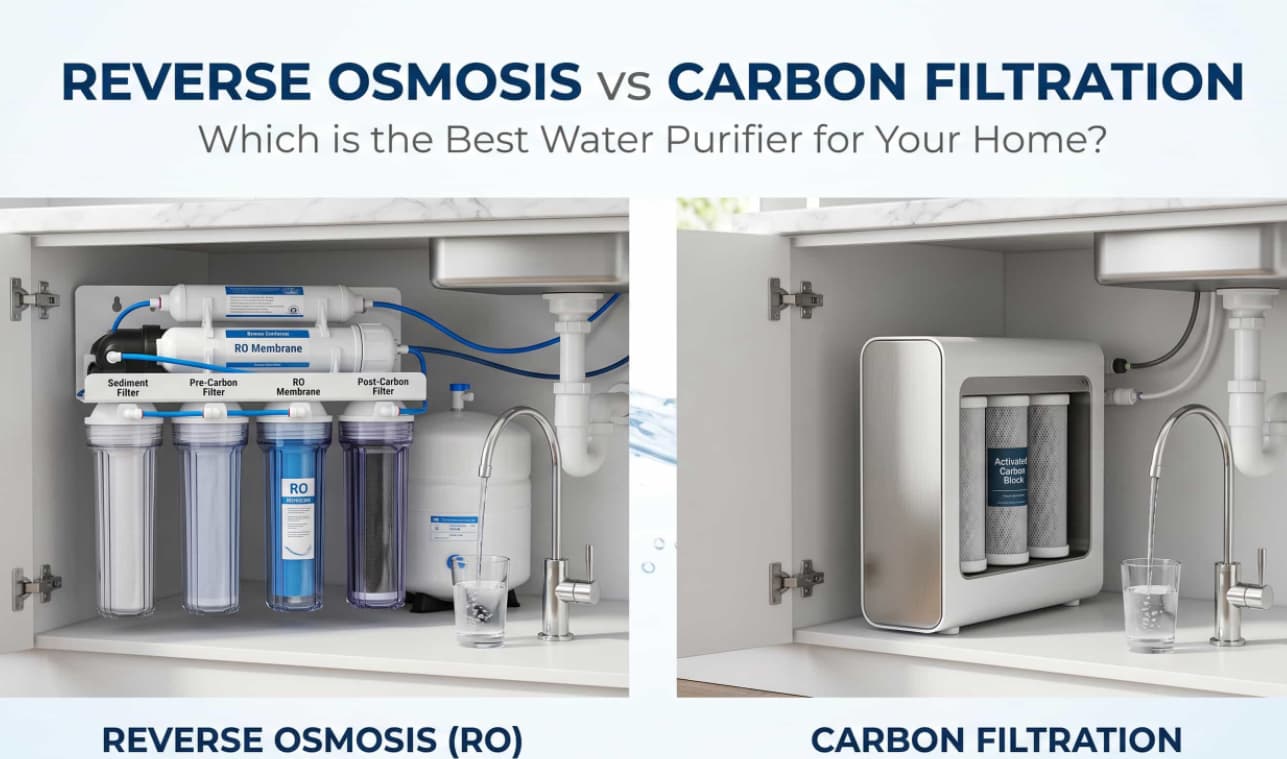
Quick answer: carbon filtration is usually the simpler choice when your main goal is improving chlorine taste and odor. Reverse osmosis (RO) is the more appropriate option when you want to reduce total dissolved solids (TDS) or address specific dissolved contaminants identified in a water report. Neither is automatically “better” for every home.
Choose carbon filtration when: your water is already suitable for its intended use, but chlorine taste, odor, or selected organic compounds are your main concern.
Consider reverse osmosis when: you want lower TDS, have a tested concern such as certain dissolved contaminants, or prefer a dedicated source of highly filtered drinking water at the kitchen sink.
The right choice starts with the water you have, not with the most expensive system. This guide explains the practical difference between reverse osmosis and carbon filtration, what each technology can and cannot do, and how to choose a system for your home.
Reverse Osmosis vs Carbon Filtration at a Glance
| Decision factor | Activated carbon | Reverse osmosis |
|---|---|---|
| Best known for | Improving taste and odor; reducing chlorine in systems designed for it | Reducing TDS and a broader range of dissolved substances in systems designed for it |
| Dissolved solids / TDS | Does not meaningfully reduce TDS | Can substantially reduce TDS |
| Lead and other contaminants | Depends on the specific filter and its certified performance claims | Depends on the specific system, membrane, and certified performance claims |
| Water sent to drain | No RO reject-water stream | Produces a concentrate stream; the ratio varies by model and conditions |
| Installation | Can range from pitcher or faucet filters to under-sink systems | Usually installed under the sink with feed-water and drain connections |
| Maintenance | Replace cartridges on schedule and based on actual water conditions | Replace pre-filters, post-filters, and the membrane according to the system manual |
How Activated Carbon Filtration Works
Activated carbon has a highly porous surface that adsorbs certain compounds as water passes through it. It is commonly used to improve chlorine taste and odor, and it may reduce other substances when the product is specifically designed and certified to do so.
Carbon filtration is not a TDS-reduction technology. Dissolved salts and many other dissolved inorganic substances can remain in the water. That is not automatically a problem: TDS is a measurement of dissolved material, not a complete safety score. The useful question is which substances are present in your water and whether the filter is certified to address them.
How Reverse Osmosis Works
A reverse osmosis system typically combines several stages. Pre-filters help protect the membrane, the RO membrane separates a large share of dissolved material from the water stream, and a post-filter may improve final taste. The concentrated stream carries rejected material to the drain.
Because RO can reduce TDS and many dissolved substances, it is often chosen for a dedicated drinking-water faucet. However, an RO system should still be selected by its documented performance claims, installation requirements, replacement-filter availability, and water-production ratio—not by the word “RO” alone.
Which System Fits Your Water and Home?
Choose carbon filtration for taste and chlorine concerns
If your local utility report and household plumbing do not suggest a specific issue, but you dislike chlorine taste or odor, a properly maintained carbon filter can be a practical starting point. It is often the lower-complexity option and does not create an RO reject-water stream.
Consider RO when TDS or a tested contaminant is the concern
RO can make more sense when a water test, local water-quality report, or household circumstance points to dissolved-material concerns. This can include elevated TDS, certain well-water concerns, or a preference for highly filtered drinking water. For private wells, test the water first: no single residential filter is the right answer for every well-water condition.
Do not assume every carbon filter or RO system makes the same claim
Lead reduction, fluoride reduction, nitrate reduction, and other contaminant claims are product-specific. Before purchasing, read the product performance data and look for the applicable certification or test documentation. A technology category alone is not proof of a particular reduction claim.
Four Questions to Ask Before You Buy
- What problem am I trying to solve? Chlorine taste, high TDS, a specific test result, or simply a more convenient drinking-water source?
- What does my water report or test show? Start with facts instead of guessing from taste alone.
- Can my kitchen support the installation? Check under-sink space, power requirements, feed-water access, and drain access.
- Can I maintain the system? Confirm replacement-filter availability, replacement intervals, and the cost of ownership before choosing a model.
Reverse Osmosis vs Carbon Filtration: Final Verdict
Carbon filtration and reverse osmosis solve different problems. Carbon is often a sensible choice for improving taste and odor. RO is the stronger option when your goal is to reduce TDS or target a broader set of dissolved substances supported by the system’s documented claims.
If you decide that an under-sink RO system is right for your household, compare Mizudo’s available flow rates, dimensions, filtration stages, and replacement-filter options before selecting a model.
Explore Mizudo Reverse Osmosis Systems
Frequently Asked Questions
Is reverse osmosis better than carbon filtration?
Not in every situation. Carbon filtration is often sufficient for chlorine taste and odor. RO is more suitable when you want TDS reduction or have a documented concern that an RO system is designed and verified to address.
Can a carbon filter reduce lead?
Some carbon-based products may reduce lead, but this depends on the individual product and its verified performance claim. Check the manufacturer’s documentation rather than assuming all carbon filters provide the same reduction.
Does reverse osmosis lower TDS?
Yes. Reducing dissolved solids is one of the defining functions of an RO membrane. TDS itself is not a complete measure of water safety, so use it together with local water-quality information or testing.
Does RO remove minerals from water?
RO reduces many dissolved minerals along with other dissolved substances. Whether that matters to you is a personal preference and should be considered alongside your overall diet and the specific reason you are filtering water.
Does every RO system waste the same amount of water?
No. Water-production ratios differ by model, incoming water pressure, temperature, and maintenance condition. Use the specification for the exact system you are considering.

%20is%20the%20more%20appropriate%20option%20when%20you%20want%20to%20reduce%20t...)
Leave a comment
This site is protected by hCaptcha and the hCaptcha Privacy Policy and Terms of Service apply.