


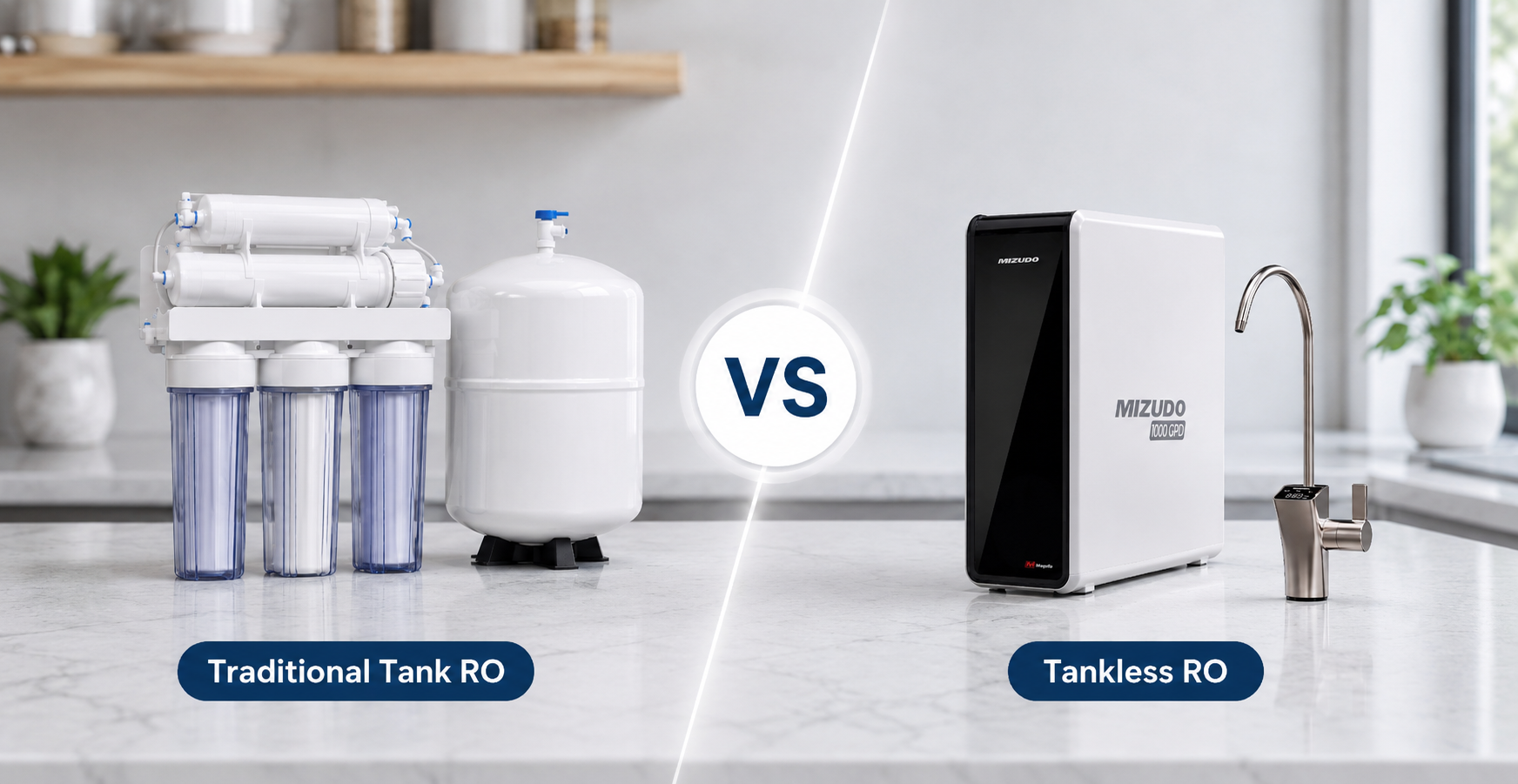
Choosing between a tankless reverse osmosis system and a traditional tank RO system is not simply a matter of choosing the newer design.
Both systems use reverse osmosis technology to reduce dissolved contaminants in drinking water. The main difference is how they produce, store, and deliver purified water.
A traditional RO system produces water gradually and stores it in a pressurized tank. A tankless reverse osmosis system uses an internal pump and a higher-capacity membrane to filter water on demand.
That difference affects cabinet space, faucet flow, water efficiency, maintenance, electricity use, and total ownership cost.
The Bottom Line
Choose a tankless reverse osmosis system if you want to save under-sink space, produce filtered water on demand, and use features such as filter-life reminders or real-time TDS monitoring.
Choose a traditional tank RO system if upfront cost is the main concern, there is no suitable electrical outlet under the sink, or you prefer a simpler system that can dispense a limited amount of stored water during a power outage.
Neither design is automatically better for every home. The right choice depends on your water-quality needs, available cabinet space, peak water demand, installation conditions, and budget.
Tankless vs. Tank RO Systems at a Glance
| Factor | Tank RO System | Tankless RO System |
|---|---|---|
| Water delivery | Produces water gradually and stores it | Produces water on demand |
| Cabinet space | Requires a pressure tank | Compact, tank-free design |
| Initial faucet flow | Usually strong while the tank is full | Depends on pump and membrane capacity |
| Continuous use | Flow may decrease after the tank empties | Designed for continued on-demand production |
| Electricity | Many systems require no power | Most systems require an outlet |
| Water efficiency | Varies by system and tank pressure | Often offers a better pure-to-drain ratio |
| Monitoring | Usually manual | Smart faucets and filter alerts are common |
| Initial price | Usually lower | Usually higher |
| Best suited for | Moderate demand and lower budgets | Limited space and higher daily demand |
How Does a Tank RO System Work?
A traditional under-sink reverse osmosis system sends tap water through prefilters and a semipermeable RO membrane. Because many residential membranes produce purified water relatively slowly, the system stores that water in a pressurized tank.
When the RO faucet opens, air pressure inside the tank pushes the stored water toward the faucet. This provides strong initial flow without requiring a large membrane or an electric booster pump.
Traditional tank systems are widely used because they are generally affordable and mechanically simple. Their main drawback is the amount of cabinet space occupied by the pressure tank. Once the stored water is used, faucet flow may slow while the system produces more purified water and refills the tank.
Tank pressure can also affect performance. As the tank fills, increasing backpressure on the purified-water side of the membrane may reduce production and efficiency, depending on the system design.
How Does a Tankless Reverse Osmosis System Work?
A tankless reverse osmosis system filters water when the faucet opens. An internal pump maintains the pressure required to move incoming water through the prefilters and a higher-capacity RO membrane.
Purified water travels directly to the faucet, while the concentrate stream carries rejected dissolved substances to the drain. Because the system produces water on demand, it does not require a large storage tank.
Modern tankless systems may also include:
- Automatic membrane flushing
- Filter-life indicators
- Real-time TDS displays
- Smart faucets
- Leak detection
- App-based monitoring
- Temperature control on instant-hot models
The tradeoff is greater complexity. Most tankless systems require electricity, and the pump may produce some sound while dispensing water or completing an automatic flushing cycle.
1. Cabinet Space
Cabinet space is one of the clearest differences between tank and tankless RO systems.
In a traditional system, the pressure tank is usually the largest component. It may compete with plumbing, a garbage disposal, cleaning supplies, or other under-sink storage.
A tankless system integrates its filters, membrane, pump, and electronic components into a compact enclosure. This can make it especially attractive for apartments, condos, galley-style kitchens, and cabinets with garbage disposals.
Before buying either type, measure the available width, height, and depth. Leave sufficient clearance for tubing, ventilation, electrical connections, and future filter replacement.
2. Flow Rate and Daily Capacity
Traditional tank RO systems can deliver strong initial flow because the water is already stored and pressurized. Once the tank empties, however, flow may decrease while the system produces more water.
Tankless systems are designed for continued on-demand production. Performance still varies considerably between models, so do not compare GPD ratings alone.
What does GPD mean? Gallons per day describes a membrane's potential daily production under specified test conditions. It is not the same as the actual dispensing speed at the faucet.
When comparing systems, check:
- Rated GPD capacity
- Gallons or liters per minute
- Time required to fill a drinking glass
- Minimum feed-water pressure
- Performance at lower water temperatures
- Performance under typical household conditions
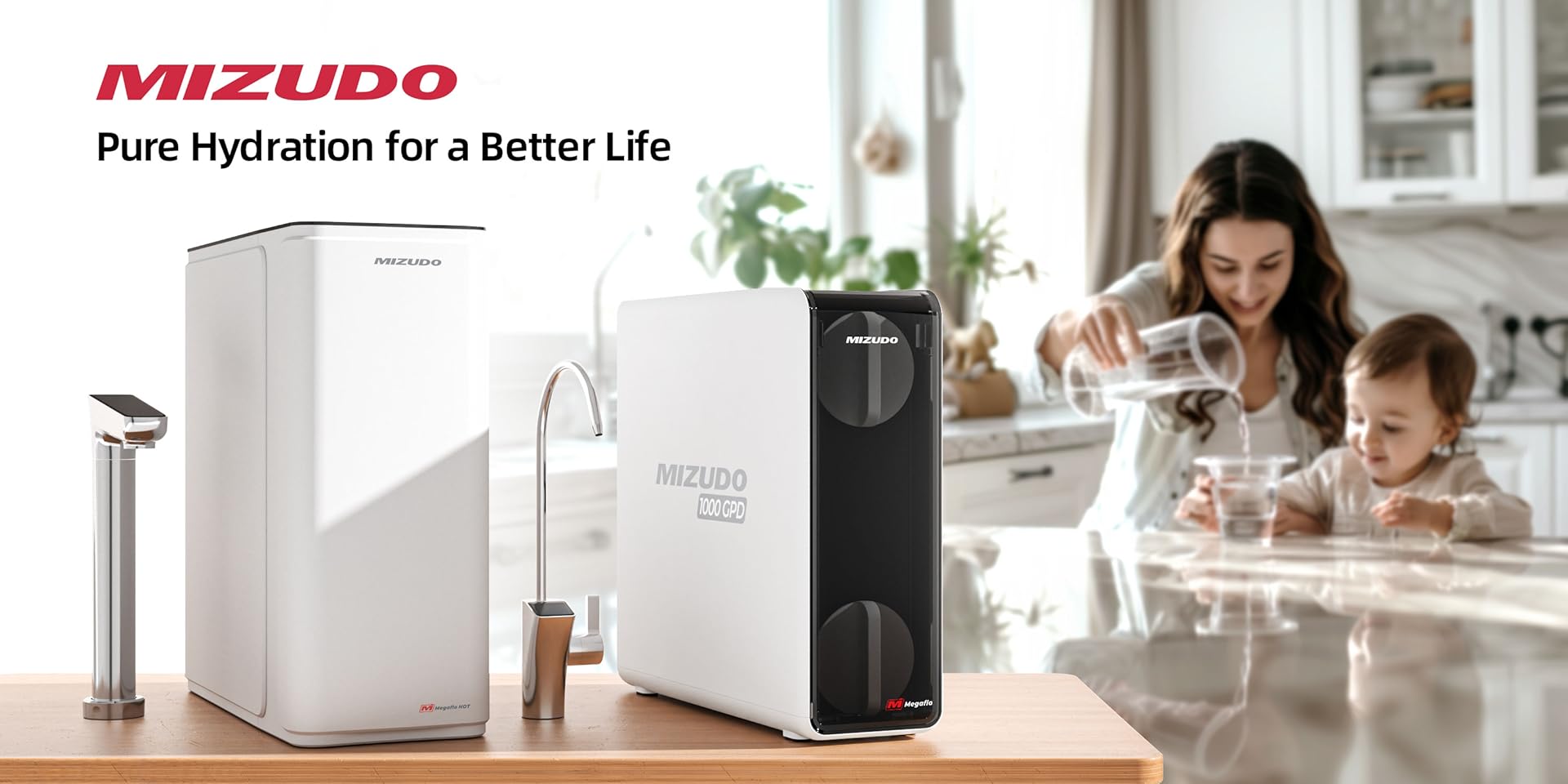
For households that need high-capacity on-demand water, the Megaflo 1000GPD Reverse Osmosis Water Filter delivers up to 0.7 gallon per minute, making it easier to fill glasses, bottles, kettles, and cooking pots without relying on a storage tank.
Actual performance may vary with incoming pressure, water temperature, source-water quality, household plumbing, and filter condition.
3. Water Efficiency
Every reverse osmosis system sends some water to the drain. This concentrate stream carries away substances rejected by the membrane and helps maintain membrane performance.
The useful comparison is the pure-to-drain ratio, sometimes presented in reverse as the waste-to-treated ratio.
- A 1:3 pure-to-drain ratio produces one gallon of purified water for every three gallons sent to the drain.
- A 3:1 pure-to-drain ratio produces three gallons of purified water for every one gallon sent to the drain.
Always confirm which number represents purified water because manufacturers do not always present the ratio in the same order.
Tankless systems often use a pump to maintain consistent pressure across the membrane. Eliminating storage-tank backpressure may also improve recovery. However, a tankless design does not automatically guarantee high efficiency.
The U.S. EPA WaterSense program requires a labeled point-of-use RO system to send no more than 2.3 gallons to the drain for every gallon of treated water produced.
The Megaflo 1000GPD delivers a rated 3:1 pure-to-drain ratio under specified test conditions. Actual efficiency may vary with feed-water pressure, temperature, source-water quality, filter condition, and system use.
4. Water Quality and Certification
Tankless systems do not automatically produce cleaner water than tank systems. A storage tank also does not automatically make filtered water unsafe.
Contaminant reduction depends on the complete filtration system, including its RO membrane, sediment and carbon prefilters, postfiltration, materials, seals, installation, filter condition, and verified reduction claims.
NSF/ANSI 58 is a key standard for point-of-use reverse osmosis systems. It addresses areas such as material safety, structural integrity, performance information, efficiency, and specific contaminant-reduction claims.
A reference to NSF/ANSI 58 does not necessarily mean that every possible contaminant-reduction claim has been independently certified. Review the exact model number, certification organization, applied standards, certified claims, and current documentation.
The Megaflo 1000GPD has been tested by CSA and SGS according to ANSI 42, 58, and 372 standards. Review the available testing information and performance data when comparing specific reduction and performance claims.
Does Tankless RO Water Taste Better?
Tank or tankless design alone does not determine taste. Source-water quality, membrane performance, carbon postfiltration, filter age, household plumbing, and optional remineralization can all affect flavor.
Reverse osmosis typically reduces dissolved minerals along with other dissolved substances. Households that prefer a more mineral-like taste may consider a compatible remineralization filter approved for their system.
5. Maintenance and Filter Replacement
Neither tank nor tankless RO systems are maintenance-free. Sediment and carbon prefilters protect the membrane, while the membrane and postfilter have their own replacement schedules.
Actual filter life depends on household water consumption, source-water TDS, sediment, chlorine, hardness, pressure, temperature, and filter condition.
Traditional systems add a pressure tank that must remain correctly pressurized and properly sanitized. Tankless systems eliminate the large tank but add pumps, sensors, electronic controls, and model-specific cartridges.
Before buying, compare:
- Replacement filter prices and availability
- Membrane replacement frequency
- Whether tools or water shutoff are required
- Filter access inside the cabinet
- Filter-life indicators
- Pump and electronics warranty
The Megaflo 1000GPD's PCF filter is designed to last up to 12 months, while its RO membrane can last up to 36 months. Actual life depends on household use, source-water quality, and operating conditions.
6. Electricity, Noise, and Power Outages
Many traditional tank RO systems can operate without electricity. This may be useful when there is no outlet under the sink, electrical installation would be difficult, or power outages are frequent.
If the pressure tank is full, a traditional system may dispense a limited amount of stored drinking water during an outage, provided suitable plumbing pressure remains available.
Most tankless systems require electricity for the pump, smart faucet, TDS monitoring, automatic flushing, leak detection, and electronic controls. The pump may be audible while producing water or performing a flushing cycle.
Before installation, confirm that a suitable outlet is available and check the voltage, cord length, grounding requirements, cabinet conditions, and applicable local codes.
7. Refrigerator and Ice-Maker Compatibility
Do not assume every under-sink RO system can connect directly to a refrigerator, ice maker, coffee machine, or other appliance.
Traditional tank systems can often support a separate appliance line because the tank provides stored water and pressure. Distance, tubing size, elevation, and pressure loss still need to be considered.
The Megaflo 1000GPD is not designed for direct connection to a refrigerator or ice maker. A compatible pressure-regulating tank and bypass filter are required for this type of installation. Confirm the approved installation method before modifying the system.
8. Purchase Price and Long-Term Cost
Traditional tank RO systems usually cost less upfront. Tankless systems often cost more because they may include a high-capacity membrane, internal pump, compact housing, sensors, smart monitoring, and automatic flushing.
To compare the real cost, estimate ownership over three to five years:
- Initial purchase price
- Installation and possible electrical work
- Replacement prefilters and membrane
- Water sent to the drain
- Electricity use
- Tank sanitizing or system servicing
- Potential repair costs
- Warranty coverage
A more expensive tankless system may be worthwhile when it solves a genuine problem, such as limited cabinet space or high peak demand. Paying for capacity or smart features you will not use does not automatically improve filtration performance.
Which RO System Should You Choose?
Choose a Tank RO System When:
- Your initial budget is the deciding factor.
- You do not have an outlet under the sink.
- Power outages are common.
- You have enough space for a pressure tank.
- Your household has moderate filtered-water demand.
- You prefer a simpler mechanical design.
Choose a Tankless RO System When:
- Under-sink cabinet space is limited.
- You frequently fill bottles, kettles, and pots.
- You want on-demand production.
- Water efficiency is an important consideration.
- You want filter reminders or TDS monitoring.
- You have a suitable electrical outlet.
Find the Right Tankless RO System
Compare faucet flow, cabinet size, pure-to-drain ratio, filter life, smart features, and temperature options across our under-sink RO systems.
Compare RO SystemsA Practical RO Buying Checklist
- Check what is in your water. Review your utility's annual report or use an accredited laboratory for a private well.
- Identify the substances you need to reduce. Match your concerns with verified claims for the exact model.
- Estimate peak filtered-water demand. Include bottles, cooking, coffee, tea, and pets.
- Measure the cabinet. Account for pipes, disposals, outlets, hinges, tubing, and filter access.
- Compare actual faucet flow. Do not rely on the GPD rating alone.
- Verify the pure-to-drain ratio. Confirm which number represents purified water and whether flushing is included.
- Calculate three-year filter cost. Include every cartridge and membrane.
- Confirm appliance compatibility. Check refrigerator and ice-maker requirements before installation.
For more help matching filtration technology to your water and household needs, read our guide to choosing a drinking-water filter.
Frequently Asked Questions
Are tankless reverse osmosis systems good?
Tankless reverse osmosis systems can be an excellent choice for homes that need compact installation and on-demand filtered-water production. Compare verified reduction claims, faucet flow, water efficiency, filter costs, pump noise, installation requirements, and warranty coverage for the exact model.
Are tankless RO systems worth the higher price?
A tankless RO system may be worth the higher initial price when cabinet space, peak water demand, efficiency, or smart monitoring matters. A tank system may offer better value when affordability, simplicity, or operation without electricity is more important.
Does a tankless RO system waste less water?
It can, but not every tankless system is equally efficient. Compare the tested pure-to-drain ratio for the exact model and check whether automatic flushing water is included.
Does a tankless RO system work during a power outage?
Most electric tankless RO systems cannot produce water without power. A traditional system may dispense a limited amount of water already stored in its pressure tank.
Is 1000 GPD too much for a home?
A 1000 GPD rating represents potential membrane production under specified conditions; it does not mean a household must consume that amount. Higher capacity can support faster on-demand flow, but faucet flow, efficiency, cabinet size, filter cost, and household demand also matter.
Can a tankless RO system connect to a refrigerator?
Some models can, but they may require additional components to maintain suitable pressure and flow. Confirm compatibility and the approved installation method for the exact model before connecting it to a refrigerator or ice maker.
Final Verdict
In the tankless reverse osmosis system vs. tank RO comparison, neither design is best for every household.
A traditional tank system offers a lower initial price, simpler operation, and limited stored-water availability. A tankless system offers a smaller footprint, continued on-demand production, and modern monitoring, usually with a higher purchase price and an electricity requirement.
Start with your water-quality needs, cabinet dimensions, peak demand, installation conditions, and long-term filter cost. That approach will lead to a better decision than simply choosing the system with the largest GPD number or the longest list of filtration stages.

Leave a comment
This site is protected by hCaptcha and the hCaptcha Privacy Policy and Terms of Service apply.