The 2026 Guide to Condensing vs Non Condensing Tankless Water Heaters
ealing with the frustration of high energy bills and running out of hot water is a problem no homeowner should face in 2026. As traditional, bulky tank heaters become a thing of the past, the shift to modern, on-demand tankless technology is accelerating. However, simply switching to "tankless" isn't enough; you need to choose the right underlying gas technology to maximize your investment.
At Mizudo, our engineering team—backed by industry-leading production facilities and certifications from UL, CSA, and Energy Star—is dedicated to manufacturing high-end, cost-effective water heating solutions. We know that objective understanding is the absolute key to long-term savings. In this guide, we will break down the industry's biggest debate with real-world data to help you navigate the economics of modern plumbing.
What is Condensing Tankless Water Heater Technology?
If you are just beginning to research your home upgrade, you are likely asking: exactly what is condensing tankless water heater technology, and how does it actually lower utility bills?
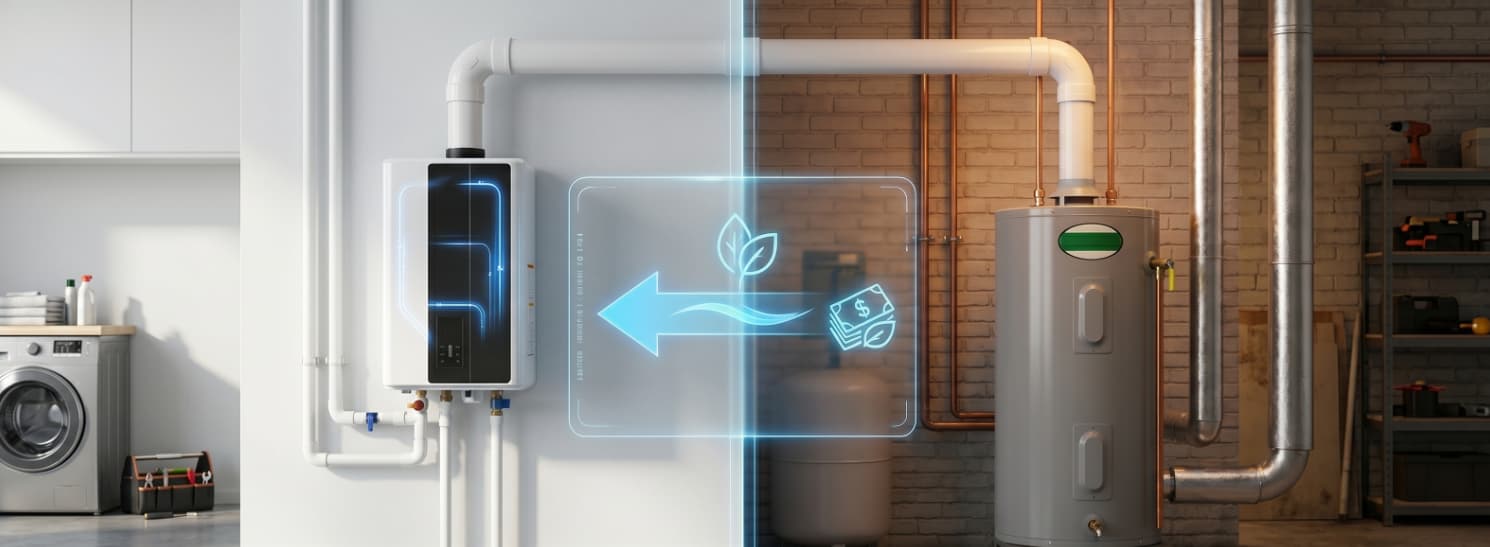
In engineering terms, a condensing unit utilizes a dual-heat-exchanger system (primary and secondary). Instead of letting extremely hot exhaust gases escape immediately, the system traps and reuses that residual heat to pre-warm the incoming cold water before it reaches the primary heating chamber.
According to the U.S. Department of Energy (DOE), this ingenious recycling process pushes the Uniform Energy Factor (UEF) to 0.90 or higher, drastically cutting your monthly gas consumption. Furthermore, because the exhaust gases are significantly cooled down, homeowners and plumbing contractors can use much cheaper standard PVC or CPVC piping for venting.
The Hidden Drawbacks of Condensing Units
To make an informed decision, it is crucial to understand the limitations of condensing models:
- Acidic Condensate: The condensation created during the heat extraction process is naturally acidic. These units require a condensate neutralizer filter to treat the water before it safely drains into your home's plumbing system.
- Higher Maintenance: The neutralizer media typically needs replacement every 12 to 24 months, adding a recurring maintenance task.
- Space and Drainage Requirements: Because they produce liquid condensate, the installation location must have access to a floor drain or a condensate pump, and the units are generally heavier and slightly larger than traditional models.
Understanding Traditional Non-Condensing Technology
To fully evaluate your options, you must also understand the older traditional method: the non-condensing water heater. These units rely on a single heat exchanger. Once the water is heated, the resulting exhaust gases—which can exceed 300°F (150°C)—are vented straight outside your home.
The True Cost of Non-Condensing Systems
While a non-condensing unit might look cheaper on the store shelf (often ranging from $700 to $1,900 for the unit alone), it comes with hidden long-term and immediate installation drawbacks.
First, the thermal efficiency is noticeably lower, typically hovering around a 0.80 UEF, meaning roughly 20% of the gas you pay for goes literally out the exhaust pipe. Crucially, because the exhaust is so hot, building codes require expensive, thick, corrosion-resistant stainless-steel venting (Category III).
Condensing vs Non Condensing Tankless: The Data-Driven Comparison
When evaluating condensing vs non condensing tankless systems, the decision ultimately comes down to total plumbing economics and your specific household needs. Here is how they stack up based on current AHRI (Air-Conditioning, Heating, and Refrigeration Institute) data and average U.S. contractor rates:
| Feature / Metric | Condensing Gas Tankless | Non-Condensing Gas Tankless |
|---|---|---|
| Energy Efficiency (UEF) | 0.90 - 0.98 (Energy Star Rated) | 0.80 - 0.82 (Standard) |
| Average Unit Price | $1,400 - $3,200 | $700 - $1,900 |
| Venting Material Costs | PVC/CPVC ($3 - $6 per linear foot) | Stainless Steel Cat III ($18 - $35 per foot) |
| Drainage Requirement | Yes (Requires floor drain/pump) | No |
| Estimated ROI Timeline | 4 to 6 Years | N/A (Lower upfront, higher running cost) |
Analyzing the Venting and Installation Costs
This is where real-world costs diverge. The cheaper PVC venting allowed by condensing units ($3-$6/ft) often offsets the higher cost of the unit itself. Conversely, the Category III stainless steel venting required for non-condensing units ($18-$35/ft) can drive the final contractor bill up by hundreds or even thousands of dollars depending on the distance to your exterior wall or roof.
Tankless Water Heater Condensing vs Non Condensing: Which is Right for You?
So, in the debate of a tankless water heater condensing vs non condensing setup, which one actually wins? The truth is, there is no one-size-fits-all answer; it depends entirely on your household scenario.
When to Choose a Condensing Unit
- Large Households: Homes with 3+ family members using high volumes of daily hot water will maximize the fuel-saving benefits.
- Cold Climates: If your incoming groundwater is very cold, the secondary heat exchanger does a lot of heavy lifting, saving substantial gas.
- Long-Term Homeowners: If you plan to stay in your house for 5+ years, the 4-6 year ROI timeline makes condensing technology highly profitable.
When to Choose a Non-Condensing Unit
- Small Households & Empty Nesters: If you use minimal hot water, the fuel savings of a condensing unit may never cover the higher initial purchase price.
- Warm Climates (Sunbelt States): With warmer groundwater, less energy is required overall, making the extreme efficiency of a condensing unit less critical.
- Short-Term Rentals & Quick Flips: If upfront budget is the absolute primary concern and you aren't paying the long-term gas bills, non-condensing units offer a lower barrier to entry (provided venting runs are very short).
Why Mizudo is the Premium Choice for Your Home (and Business)
Understanding the technology is only half the battle; sourcing it from a reliable manufacturer is the other. At Mizudo, we don't just assemble parts; we engineer complete thermal solutions tested to the highest North American standards.
Utilizing state-of-the-art manufacturing equipment, our high-end condensing gas water heaters are built to deliver consistent performance, offering a smart alternative to overpriced legacy brands.
- For Homeowners (B2C): Mizudo delivers Energy Star-certified, high-efficiency condensing technology that actually pays you back. We bring true value to your household with robust engineering that minimizes maintenance headaches.
- For US Plumbing Contractors & Wholesalers (B2B): Partnering with Mizudo means securing a reliable supply chain of top-tier products. Our unbeatable cost-effectiveness allows you to protect your margins while offering your clients a superior, easy-to-install product with cheap PVC venting compatibility.
Every Mizudo unit is backed by a comprehensive warranty and a dedicated support team, proving that we stand firmly behind the engineering of every heater that leaves our factory line.
Contact Mizudo Today
Whether you are a homeowner calculating your next energy upgrade, or a US distributor looking to partner with a top-tier manufacturing powerhouse, our team is ready to assist you.
Get in touch with us:
- Email: service@mizudo.com
- Phone: +001-781-887-0291
- Website: www.mizudo.com
Frequently Asked Questions (FAQ)
What is the main difference between condensing and non-condensing tankless water heaters?
The primary difference lies in efficiency and venting. Condensing units use a secondary heat exchanger to reuse exhaust heat, achieving over 90% efficiency and allowing for cheaper PVC venting. Non-condensing units vent hot exhaust directly outside, requiring expensive stainless-steel venting and operating at around 80% efficiency.
Do I need a floor drain for a condensing tankless water heater?
Yes. Condensing tankless water heaters produce acidic liquid condensate during the heat extraction process. This liquid must be treated through a neutralizer and then routed to a floor drain or removed using a condensate pump.
Are condensing tankless water heaters worth the extra cost?
For most long-term homeowners, yes. While the initial unit cost is higher, the savings from cheaper PVC venting during installation and the 10-15% reduction in monthly gas bills usually provide a full return on investment (ROI) within 4 to 6 years.
About the Author: This guide was reviewed and authored by John Davies, Lead HVAC Design Engineer at Mizudo, holding over 15 years of experience in thermal dynamics and residential plumbing systems. Alongside the Mizudo Research Team, John is dedicated to educating consumers and engineering high-end, cost-effective condensing water heaters for households and wholesale partners worldwide.