


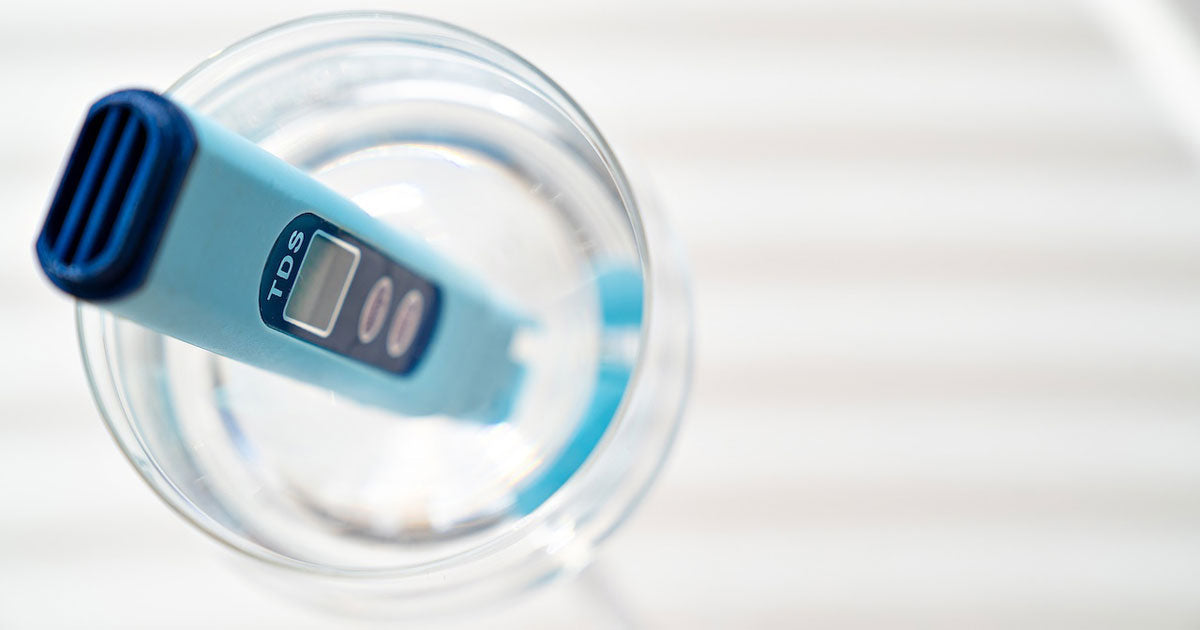
What is a Good TDS Level for Drinking Water? Your 2026 Homeowner's Guide
Quick answer: There is no single “normal” or “ideal” TDS level that proves drinking water is safe. A TDS meter estimates the amount of dissolved material in water; it does not identify that material. Use the reading as one data point alongside your local water report, plumbing conditions, and—when needed—a targeted water test.
For taste and everyday context: the U.S. EPA lists 500 mg/L as a non-enforceable secondary standard for total dissolved solids. It relates mainly to taste, appearance, and mineral deposits—not a pass/fail health determination.
For a purchase decision: choose a system based on the specific outcome you want. Carbon filtration is often used for chlorine taste and odor; reverse osmosis is designed to reduce total dissolved solids and other dissolved substances covered by a system’s documented performance claims.
Understanding a TDS reading can help you notice changes in your home water, but the number needs context. This guide explains what TDS means, what a meter can and cannot tell you, and when an under-sink reverse osmosis system may make sense.
What Does TDS Mean in Drinking Water?
TDS stands for total dissolved solids. It is a broad measurement of material dissolved in water, commonly expressed as parts per million (ppm) or milligrams per liter (mg/L). Depending on the source, TDS can include minerals such as calcium and magnesium, as well as salts and other dissolved substances.
Higher TDS does not automatically mean unsafe water, and lower TDS does not automatically mean safer water. The reading cannot tell you which dissolved substances are present or whether they are at a level of concern.
How to Interpret a TDS Reading
| Reading | What it may indicate | Useful next step |
|---|---|---|
| Below 50 ppm | Low dissolved-mineral content; this is common after RO filtration. | Do not treat the number alone as proof of water safety or quality. |
| 50–300 ppm | A range many households may see; taste and source conditions vary widely. | Compare it with your local water report and your own prior readings. |
| Above 500 ppm | May be associated with noticeable taste, mineral deposits, or scaling. | Review the water source and consider a targeted test if the reading is unexpected or changing. |
| A sudden change from your normal reading | A change in source water, plumbing, filter condition, or measurement method. | Repeat the measurement correctly, check your utility report, and test for specific concerns where appropriate. |
The EPA’s 500 mg/L secondary standard is a useful reference point for aesthetic effects. It is not a health-based maximum contaminant level, and it should not be used as a diagnosis for a specific contaminant.
What a TDS Meter Can—and Cannot—Tell You
Most handheld TDS meters estimate dissolved solids from electrical conductivity. They are useful for comparing readings over time or checking whether an RO system is lowering the overall dissolved-material reading. They do not directly measure every substance in the water.
A TDS meter can help you:
- Track changes in a water source over time.
- Compare tap-water and filtered-water readings.
- See whether a filtration system is reducing overall dissolved solids.
A TDS meter cannot tell you:
- Which specific dissolved substances are present.
- Whether lead, PFAS, bacteria, or other individual contaminants are present at a level of concern.
- Whether water meets every applicable drinking-water requirement.
If you are concerned about a specific contaminant, use your utility’s Consumer Confidence Report or a laboratory test designed for that contaminant. Private-well owners should use regular, location-appropriate water testing rather than relying on a TDS meter alone.
Why TDS Can Be High
TDS can rise naturally as water passes through mineral-rich soil and rock. It can also reflect salts, hardness minerals, seasonal source-water changes, or other dissolved material. A high reading is a prompt to ask better questions about the source—not a complete answer by itself.
Hard water and high TDS are related but not identical. Hardness usually refers mainly to calcium and magnesium. A water softener changes hardness through ion exchange; it does not necessarily lower a TDS reading because dissolved ions remain in the water.
When Does Reverse Osmosis Make Sense?
Reverse osmosis is a practical option when you want a dedicated source of drinking water with lower TDS, or when your water testing and system documentation point to a specific need an RO system is designed to address. A typical under-sink RO system uses pre-filtration, a membrane, and post-filtration; the exact performance and maintenance schedule vary by model.
RO is not automatically necessary for every home. If chlorine taste or odor is the only issue, carbon filtration may be the simpler fit. For a detailed comparison, see Reverse Osmosis vs Carbon Filtration.
Before choosing an RO system, confirm your under-sink space, water and drain connections, replacement-filter availability, and the documented claims for the exact model.
Explore Mizudo Reverse Osmosis Systems
How to Use a TDS Meter at Home
- Use a clean glass and follow the meter manufacturer’s instructions.
- Measure the same water source in similar conditions each time.
- Record the date and reading so you can identify a meaningful trend.
- If a result is unexpected, repeat it before drawing conclusions.
- Use a certified lab test or utility report for questions a conductivity meter cannot answer.
Frequently Asked Questions
What is a normal TDS level for drinking water?
There is no single normal or ideal number for every home. TDS varies by geography and water source. The EPA lists 500 mg/L as a secondary, non-enforceable standard related primarily to taste and other aesthetic effects.
Is a low TDS reading always better?
No. Low TDS means less dissolved material, but it does not identify what is or is not present in the water. It should not be treated as a complete safety result.
Can a TDS meter detect lead or PFAS?
No. A handheld TDS meter cannot identify individual contaminants. Use a test designed for the specific contaminant you are concerned about.
Does boiling water lower TDS?
Generally, no. As water evaporates, dissolved solids remain behind, so their concentration in the remaining water can increase.
Do water softeners lower TDS?
Not necessarily. Water softeners exchange hardness minerals for other dissolved ions, so they may change hardness without producing a lower TDS reading.
Does reverse osmosis lower TDS?
Yes. Lowering dissolved solids is a core function of an RO membrane. The actual result depends on the water source, system design, maintenance, and the specific model.

Leave a comment
This site is protected by hCaptcha and the hCaptcha Privacy Policy and Terms of Service apply.